Friday, July 23, 2010


LINING-OFF THE FIELD

My father handed me the flags and paid
out string from where he stood
at home, waving me deeper, waving me right
or left, “More left. A little less. Yes.
Good.” Then with the string held high,
a wind-rolled arc
between us, I ran hard across
the outfield and we set the Left-field flag.

Suppose the string were one thread of a sail;
the way it would belly, filling
with assurance. Say that where he stood on it
it entered the ground
so if I pulled I’d pull forever, all of it --
the whole ball -- one unbroken strand.
Or say I doubled back
to a snag in crabgrass or a patch of dandelion
too late and saw my father
chasing the end that got away from him.

Suppose the lines go on beyond the flags,
embracing houses, trees,
so many men and women, strangers
turning into friends or enemies, so many lovers,
towns, forests, lakes, rivers, stories
told and heard, forgotten or remembered,
understood or not. suppose the lines go on
because they do; imaginary, real.

Wednesday, July 21, 2010


HISTORY

The pebble my son
spraypainted gold

rests in my palm, a gift,
and asks, as if

in his sweet, high, temporary voice:
who taught me my life

is lead and needs great pain
to turn itself to gold?

And who taught them?
And for what, and whose, reasons?

Thursday, July 15, 2010


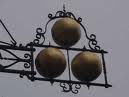
HOCKSHOP

It’s a window next to impossible
to miss unless
you’re hurrying to a particular place
or obsessed with a recent song, or carrying
a face, not just anyone’s,
with you at the time.

I confess I’ve stood there
under the sign lettered GUNS - JEWELRY - LOANS
many times, the window full of
risked, lost, or stolen things,
grieving people’s or dead people’s things,
novelties and knives.

Guilt. Indecision. Everything
is used; each of the hundreds of watches
shows a different time. Guitars,
untuned, hang carefully, gratefully
silent. Which ones, of these alarm clocks,
above the guns, above the stuffed owls,

have cut off a dream and sent a man out
to his death? Some of these paintings,
stacked on the floor, have hung in the finest
banks, and, although it’s kept quiet,
there are those who’ll say the diamonds
were swept from the highway after a fatal crash

that no one remembers. Not even
the broker, the nodder, the blank-faced one
who asks no questions, who, come night,
empties the window, leaves the drawer open
and empty, leaves one light on, sighs,
locks up, drags shut the rusty gates.

Wednesday, July 14, 2010


MESSENGERS

The house itself, if it had a voice
Would speak out clearly. As for me,
I speak to those who understand;
if they fail, memories are nothing.

— Aeschylus,
Agamemnon


We say what we know because we must.
You can cheer us or run us out of town.
It’s nothing at first, like rain on dust,

a hairline crack in the faultline’s crust,
a tentative first-person plural pronoun.
We say what we know because we must

recall, recount, redeem, and readjust
all that we’ve known, not for renown.
It’s nothing at first, like rain on dust,

or the first few tiny flecks of rust
on barrels buried underground.
We say what we know because we must

talk back to histories we do not trust,
relearn our own, and set them down.
It’s nothing at first, like rain on dust.

What does it mean to fear what’s just?
You can cheer us or run us out of town.
We say what we know because we must.
It’s nothing at first, like rain on dust.

Friday, July 09, 2010


NUDE DESCENDING A PRAYER

Father Art, on earth, above those past
the hours of their deaths, thou Mother
under us for who knows how long now,
thy names be with me. Fruit of wills
repeatedly and variously done on earth,
who will pray for us? Sinners? I believe
in clay and constellations and what accidents
allow us to forgive ourselves again for being
in such debt, for owing bread, for being tempted
to make believe, to lie, to sleep forever. Amen.

Tuesday, July 06, 2010


Another from Without Paradise:


THE SLOTH

I live entirely for my own sake.
I once had friends, some money, plans, a love,
but what the hell, what difference does it make?

These days it doesn’t pay to stay awake.
I’ve got what I need. I’ve got nothing to prove.
I live entirely for my own sake.

I was the best but couldn’t catch a break.
So here I hang. I should be hanging in the Louvre!
But what the hell, what difference does it make?

Just thinking of work gives me a headache.
I like it here, a bit above it all; why move?
I live entirely for my own sake.

I’ve taken all the shit I’m gonna take.
So take your shining mottoes, squat, and shove.
But what the hell, what difference does it make?

Your lives, your loves, your work: they’re fake.
You’re all stuck in the same timekilling groove.
I live entirely for my own sake.
What the hell, what difference does it make?

Monday, July 05, 2010


It's been a long time since I posted anything here. I only occasionally repost from another blog or website because I had wanted this to be a place where I would make my own contributions to the "genre" of the weblog. This isn't the site of my work, either; that's still my notebook. Having grown up writing with a fountain pen, not moving to the typewriter until my twenties, it is still a great pleasure for me to write in longhand, which is, I think, closer to the speed of my thinking. (I hasten to add that I am in other ways cutting-edge: facebook page, an iPhone, etc.) My point here is to define and more tightly focus this blog. For the next few days or weeks, I will post poems — sometimes with accompanying images — from my first collection, Without Paradise. Although the book is still available, copies are limited now. (I still have a box, and sometimes sell them when I read from the latest book.)

Here is the poem that opens that book:


ELEGY

— for Michael Stephen Hoffman, 1957-1970

Being in us in his new life
is as strange for him
as it is for us to be here

at his grave today
with no one else’s footprints in the snow
and only the trees that guided us

so let it not be winter there.

Tuesday, April 06, 2010


I'm very proud to be a small part of Thoughtcast, which Jenny Attiyeh describes as "a watering hole for ideas." She recorded my reading at The New England Poetry Club on the occasion of my receiving their Sheila Motton Award for best book published in the previous two years. I read with Wendy Mnookin, whose The Moon Makes Its Own Plea is among my favorite recent books.

If you are unfamiliar with this remarkable site, spend some time there. Terrific interviews, thoughtful and thorough. Great readings. Wonderful links.

Saturday, March 20, 2010


I am incensed by a news article in the Boston Globe today, “Pope to deliver apology to Ireland.” I have seldom seen such a cynical acceptance of the public relations dictum “perception is all.” The article seems to agree that the problem is the Catholic Church’s “image,” and not the worldwide criminal conspiracy recently brought to light by brave survivor-activists who compared notes, documented the paths of destruction left by pedophile priests, and refused to be silenced. It has seemed to me of late that The Boston Globe has been trying hard, since the fine work of its Spotlight Team exposing the abuse of kids in the Boston Archdiocese, to kiss and make up with the church. Lots of pictures of Cardinal O'Malley, lots of space allowed him to weigh in on moral and political matters, lots of pictures of him with the homeless, or recently, walking around Haiti in his sandals and humble brown robe. An article about the church's PR problem is not just kissing and making up, it is, well, ass-kissing. It makes the church the victim. It pretends to tell us about good men trying to recover from what some bad men did; never mind that they are the same men. The reporter, Shawn Pogatchnik, fills column-inches with a story. He includes a few quotes. And he steadfastly refuses to tackle the real subject.

A simple gathering of the figures from Ireland, Australia, New Zealand, Canada, and the United States puts the number of children violated at, easily, a million. Add in the numbers coming from other European nations, South America, and Africa, and we approach something like the real scope of this institutional depravity. If we further bear in mind that these numbers reflect only the latest generation of clandestine exploitation and not the earlier decades and perhaps centuries of it, then we begin to see the depth of it as well.

All the pope’s robes and regalia cannot hide his own history. His directive to bishops worldwide as Head of The Congregation for the Doctrine of the Faith (a bureau that was once called The Congregation for the Propagation of the Faith, a.k.a. The Inquisition) insisted that the abuse of minors be regarded as a matter of church business first and last. The oldest hierarchical, quasi-military chain of command on the planet reinforced its claim as a totalitarian Ministry of Information in that document, reminding the bishops that their first allegiance was to Rome. It is that reinforced chain-of-command which must soon tighten round this pope’s neck as it is shown over and over, in court after court, in country after country, that his bishops obeyed his orders to keep silent, evade the questions of civil authorities, and protect predators.

One has to wonder if these priests didn’t sign on to be priests in the first place precisely for the guarantee of that protection. In any case, it is clear from the forceful insistence on obedience and silence of Cardinal Ratzinger’s edict that he was aware of the scope and depth of priestly criminality and its longstanding cover-up. He must also have understood the devastating consequences of full exposure. The Catholic Church is shaken, rightly, to its foundations as a professed force for good in the world by the increasing evidence that it has been among the world’s major forces of the ongoing persecution of innocents. Cardinal Ratzinger knew, and knows now as pontiff, that this is not a PR problem.

In the story, it’s always the child who points out that the emperor has no clothes. But it takes an adult to point out that in addition to being naked, he’s also ugly — deeply, morally, spiritually ugly.

Tuesday, March 09, 2010


This fine essay is reposted from wood s lot. I believe it gets to the root of our condition, i.e. it’s a truly radical analysis of not only our economic, but also our social and spiritual devastation.

HOW WALL STREET TRANSFORMED WORK IN AMERICA

by Etay Zwick

…Pick up the New York Times today, and you’re likely to read yet another article about finance’s infidelity with the general public, another violation of the (invisible) norms of propriety. It is only with immense discipline, a well-stocked inventory of financial jargon and a readiness for self-deception that one can actually distinguish these “violations” from business-as-usual. Yet despite ubiquitous references to Wall Street offenses, maybe even because of them, Americans don’t seem deeply troubled, or even all that perplexed, that this abusive sector remains largely undisturbed. Most of us can dutifully recite the scandals and statistics, but few dare to imagine life without Wall Street. For all the talk of a rapidly evolving economic environment, we treat one feature of this environment as permanent: the existence of a class of individuals who make millions by making nothing. We’re no longer surprised to see business elites divine exorbitant bonuses, paid for through record unemployment levels and unprecedented government support. This trick is getting old.

Though Wall Street consistently updates its instruments and practices, one governing rule has remained since Veblen’s time: financial propriety has nothing to do with social and economic growth. Certain rules must be followed, but the construction of those rules is absolutely distinct from considerations of general social welfare. Rather, regulations and rules are defined according to the culture’s metric of success, of value, of esteem—and that metric is money. All financial practices that increase the wealth of the sector are not merely permitted, they are required. No profitable innovation can be ignored. Destabilizing the global economy is fine. Undermining one’s firm, or jeopardizing the system of trading and speculating, is not.

Finance today is not geared toward getting entrepreneurs the credit they need to actualize their good ideas. It is riddled with archaic social forms that perpetuate barbaric status anxieties. The appeal of the Wall Street lifestyle—money, clean working conditions, (paradoxical) status as stewards of prosperity—has blighted the rest of society with its message that the best kind of work is devoid of social utility, knowledge and permanence. Nonetheless, we continue, even in the wake of economic crisis, to accept the barbarians’ rules for social and economic life. The discussion in government today revolves around minor matters of transparency and enforcement. The barbarian does not abide by rules; indeed, it is a point of pride that he knows his way around them. No matter what regulations are passed, the barbarian will figure out a way to make money from them...

READ THE FULL ARTICLE HERE, at POINT Magazine

Sunday, February 14, 2010

VALENTINE, sotto voce

May breath
on the tender
membrane
of your febrile
pinna fill your
cochlea
with fluid, and my
hammering
on your incus
ring
your tiniest bone.

— for Kathi

Wednesday, January 27, 2010


A friend sent me this. All too true on the day of the "State of the Union" address:


A woman in a hot air balloon realized she was lost. She lowered her altitude, spotted a man in a boat below and shouted, "Excuse me, can you help me? I promised a friend I'd meet him an hour ago, but I don't know where I am."

The man consulted his portable GPS and replied, "You're in a hot air balloon, approximately 30 feet above ground elevation of 2,436 feet above sea level. You are at 31 degrees, 14.97 minutes north latitude and 100 degrees, 49.09 minutes west longitude."

She rolled her eyes and said, "You must be an Obama Democrat."

"I am," replied the man. "How did you know?"

"Well," answered the balloonist, "everything you told me may be technically correct, but I have no idea what to do with your information and I'm still lost. Frankly, you've not been much help to me."

The man smiled and responded, "You must be a Republican."

"I am," she replied, "but how did you know?"

"Well," the man said, "you don't know where you are or where you're going. You've risen to where you are due to a large quantity of hot air. You made a promise you have no idea how to keep, and you expect me to solve your problems. You're in exactly the same position you were before we met, but somehow, now it's my fault."

Thursday, December 31, 2009

I won't be able to post tomorrow, so here is Issa's haiku for the turn of the year. HAPPY NEW YEAR!

New Year’s Day—
everything is in blossom!
I feel about average.

Kobayashi Issa (1763 - 1828)

Sunday, December 27, 2009


I first became aware of painter David Sholl's work on the cover of his sister Betsy Sholl's poetry collection, The Red Line. Recently I had the chance to see his works in his studio at Brickbottom Artists. As in the painting above, Sholl is a master of texture and light, freshening our vision as the best painters are able to do. Some of the paintings that most impressed me are of dogs, including his beloved lab, Farina: they're simply the doggiest dogs ever painted: captured in motion with their quizzical looks, their playful and intent mien, their canine intelligence.

You'll also find a few more radiators there. Enjoy!

Saturday, December 26, 2009

DECEMBER 26th

A BB gun.
A model plane.
A basketball.
A ’lectric train.
A bicycle.
A cowboy hat.
A comic book.
A baseball bat.
A deck of cards.
A science kit.
A racing car.
A catcher’s mitt.
So that’s my list
of everything
that Santa Claus
forgot to bring.

— Kenn Nesbit

Monday, December 21, 2009


There is a half hour interview with yours truly, speaking with Elizabeth Lund HERE. She has interviewed a number of fine poets on this site, including Meg Kearney, Fred Marchant, and Kathleen Aguero. ENJOY!

Saturday, December 19, 2009

I came across this poem (though I don't recall where or when) and just wanted to post it here. Ann Hutt Browning's book of poems, Deep Landscape Turning, was published in August, 2009, by the Ibbetson Street Press.


AN ORDINARY LIFE

When she awoke in the morning

She threw back her all cotton sheet,

Cotton woven in a far off country

By a dark skinned girl chained to her large loom.

When she went into her kitchen

She ground beans to brew her coffee,

Beans grown, roasted in a far off country

Where the tall trees were cleared off the land

For the coffee bushes to be planted

And tended by boys not in school and men

Old before their time and where all the waste

From treating the beans is flushed and dumped

In the river, adding that detritus

To the human waste and chemical run

Off already there in the gray water

And where downstream others used the water,

That dark water, for cooking and bathing.

After her children boarded the school bus,

Wearing clothing made in the Philippines,

Mauritania, Taiwan, a hodge-podge

Of imports from other worlds, far off countries,

Where sweat shops flourished,

Filled with child workers,

She went shopping:

Guatemalan cantaloupes, Mexican tomatoes,

Chilean oranges, California lettuce,

Carolina rice, Michigan peaches,

Blueberries from Maine, all bought because

In her garden she grew hybrid tea roses,

Siberian iris, cross-bred daylilies in six colors,

Held down by pine bark, chipped in Oregon.

Then she roamed the market aisle marked

"Special," and bought a basket, its colors

Imitative of Mexican folk art, made in China,

The price suggesting child or prison labor

Dyed the fronds of grass, wove the basket

And attached the label.

She ate a quick lunch of a hamburger,

The ground beef from a far off country

Where the virgin forest was burned off

So cattle could graze on tropical grass,

The bun made from Canadian wheat

And the ketchup, again those Mexican tomatoes.

She drove home to prop up her feet

On the foam cushioned sofa, turn on the TV,

Assembled in Nicaragua,

In a maquiladora by a woman

Who rose at five a.m. to walk three kilometers

To the bus, who then rode twenty-five miles

To the factory in the tax free zone,

Who worked from eight to five

With a quarter of an hour to eat

Or use the toilet,

Who got home at eight o'clock

To bathe and feed her three children,

With eighteen cents an hour in her pocket

On good days.

The woman on the sofa

Watched two soap operas

As usual on a week day,

And ate ice cream,

American ice cream.

She liked American ice cream.

She lived an ordinary life

— ANN HUTT BROWNING

Thursday, December 03, 2009


WATCH THE VIDEO of the 2008 PEN New England panel, preceded by Eric Grunwald presenting the 2008 Vasyl Stus Freedom-to-Write Award to Abdul Rahim Muslim Dost, an Afghani poet and sometime journalist who was detained for three years at Guantanamo, released, then rearrested in Peshawar for a satirical poem he'd written. His whereabouts remain unknown.

The main question we wished to explore here was why so much American literary writing seems tame and well-behaved, so unthreatening to the powers that be. While there can be no single or simple answer to that question, each of our panelists had trenchant things to say, and there is a great deal to think about here. Enjoy.

Risky Writing and the Forces That Silence It
April 10, 2008

Richard Hoffman writer, chair, PEN New England
Carole Horne general manager, Harvard Book Store
Linda McCarriston professor, creative writing, UAlaska
Mark Pawlak editor, Hanging Loose Press
Jill Petty editor, South End Press

Richard Hoffman moderates a panel discussion about the forces in the world of publishing, society at large, and our own psyches that work to silence "risky writing".

The importance of politically challenging fiction and poetry throughout history is undeniable: from Turgenev's powerful A Sportsman's Notebook, which prompted Czar Alexander II to free his country's slaves, to Ginsberg's Howl to Doris Lessing's fiction to James Baldwin's powerful and incisive essays.

Has such writing been effectively denied its audience in our day? To what extent are the barriers to risky or oppositional writing real or imagined? What are the long-term societal and cultural dangers of a safe literature, of books as mere entertainment or escape? And what are the individual author and the reader hungry for substance, to do?

PEN New England's Freedom-to-Write (FTW) Committee, in partnership with the Cambridge Forum, hosts a panel discussion about the forces in the world of publishing, society at large, and our own psyches that work to silence "risky writing," the most dangerous but often most important of an author's works. The panel, moderated by Richard Hoffman, poet, fiction writer, and author of the memoir Half the House, features Carole Horne, General Manager, Harvard Book Store; Linda McCarriston, author of Eva-Mary and other books and professor of creative writing and literary arts at the University of Alaska, Anchorage; Mark Pawlak, poet, author of Special Handling and other books, and editor of Hanging Loose Press; and Jill Petty, editor and small press publisher.

Friday, November 20, 2009


The inaugural issue of SOLSTICE is up, and it is a treasure-trove. Work by Mike Steinberg, Tanya Whiton, Roland Merullo, Pablo Medina, Kathleen Aguero, Valerie Wilson Wesley, Kurt Brown, Dzvinia Orlowsky, Anne Marie Oomen and others, including yours truly. This is the journal to watch: eclectic and adventurous, fearless and joyful, this is a gathering of voices that marks a new beginning for online literature.

Janus Head, volume 11, Nos. 1&2 (double issue) is online. Janus Head is among the most catholic explorations of current thinking in the world. An altogether remarkable journal. And the print version is always exquisitely produced as well. I have two poems in this issue, in the company of poets whose work is almost more exciting than I can stand! (Check out Betsy Sholl's new work!) You won't be disappointed.