Thursday, December 09, 2010


A friend wrote to say that Assange has done some dangerous things, putting people's lives at risk. I don't know where he gets his information. Is Wikileaks as dangerous as the mainstream media parroting what governments and megabanks feed them? Just where are those weapons of mass destruction?

Glenn Greenwald has a great article about what Wikileaks actually released and how on Salon, here.

How quickly a global manhunt began for Assange once he announced Bank of America leaks would be next. Leaks of redacted State Department cables, back-channel discussions, characterizations of foreign leaders got nothing but a lot of bad press from the corporate newsmedia. But once he threatened the BoA’s vampires with some sunlight, he was arrested on obviously trumped up charges, Visa, MC, and PayPal froze or otherwise disabled Wikileaks’ accounts, and internet providers who depend on these financial services attempted to erase Wikileaks — and even listserve and bloggers’ discussions of Wikileaks — from the internet.

The man is dangerous because he is a publisher who is off the reservation and not controlled by those who write and maintain the dream narrative we ingest via what passes for journalism.

This is precisely what we decry when the Chinese do it: prevent the people from access to information that would lead to their questioning the narrative they are spoon-fed. Or the North Koreans. Or the Iranians. Or the government of Myanmar.

Journalists who decry Wikileaks as out-of-bounds, as irresponsible, as a violator of journalistic ethics, might well remember that Wikileaks’ first story was the leak of the wanton murder of two Reuters’ journalists by a US helicopter crew. If “traditional” journalism had been fulfilling its function, unintimidated by corporate owners and military murderers, Wikileaks would be unnecessary. So instead of vilifying Assange, reporters ought to start looking for the stories buried in the relatively few documents so far released, and put a process in place for digesting and understanding the political and economic meanings of the Bank of America revelations that are imminent.

And read the Salon article noted above. It is a lie that Wikileaks indiscriminately dumped 250,000 documents onto the net.

We have a publisher now in prison who has not been charged with a crime and whose news organization has also not been charged. What's next for him? Gitmo? Extraordinary rendition?

Tuesday, December 07, 2010


How one feels about Wikileaks and its founder Julian Assange seems to depend on one's allegiance. I'm reminded of the old joke:

Lone Ranger: Tonto, we're surrounded by Indians!
Tonto: What you mean, WE, kemosabe?

If you identify, either actively or passively, with corporate capitalism's global agenda, then Assange is a criminal. If you see that same secret network of powerful interests as destructive of human freedom, a criminal conspiracy to assert and maintain state and corporate power over an increasing number of people worldwide, then Assange is a hero.

Speaking of criminality, let's refuse to be distracted by the ludicrous charges of rape with which threatened power has sought to slander him. According to Information Clearing House, both of the women who were convinced to make these complaints bragged on Twitter to girlfriends about having slept with him before the charges were even an idea. Now they are saying it was rape because a condom broke (in both cases?) and he didn't immediately stop. Enough said.

Would the New York Times have published The Pentagon Papers today? Even now, the story in the media is all about Wikileaks, not what has actually been leaked.

The Canadian blog Wood s Lot has a great gathering of material about and by Assange. It is in our interest to inform ourselves: we live in an age where the control of information is integral to the control of populations. We need to be truly informed, not spoon-fed. Here's a good place to start:

Sunday, November 28, 2010


While at the Vermont Studio Center in September, working on a nonfiction project, I spent a wonderful afternoon with my former student, the essayist Sarah Stromeyer and her husband, sculptor David Stromeyer, walking the acreage adjacent to their home, viewing David’s stunning work. That field, in Enosburg, is testament to his long and innovative career working in metal. It was astonishing. He had to build, first, the means to make these exquisite things — tons of steel, cut, shaped, intricately assembled, moved — each and every stage an almost insurmountable engineering problem, and yet each looks light enough — or some of them do — to blow away in a strong wind. Not to mention the colors! And the way they take the light.

I visited David’s workshop and forge, where steel an inch thick or greater is bent, beveled, turned. A massive enterprise that begins with manipulating tiny cardboard models proceeds to mathematical modeling which must take into account the tensile properties of the materials, and the placement of bolts and welds must be accurate to the millimeter in order to make the whole thing work. Artist, mathematician, physicist, geologist, and engineer — David’s integrated understandings of these several disciplines make possible sculptures of an almost unearthly beauty.

Returning to my own work, the problems of composition appeared to me analogous: knowing how much weight a scene might bear, where and what kinds of transitions — like spot-welds — had to be placed in order to bring my themes together in unexpected but structurally sound ways, and how the various parts might be colored, i.e. emphasized or muted, in order to present a coherent and interesting whole. I remain grateful for David’s work on many, many levels.

Tuesday, October 05, 2010


PROCESSION: AFTER A PHOTOGRAPH BY JOSEF KOUDELKA

It only looks as if the boy
on the bike, in his angel costume,
is pulling the heavy load,
drayhorses and all, that we cannot see.
Like the faces of the domestic beasts,
his face says he is only halfway present.
He has learned to steer with one hand.

And it only looks as if the stolid crone
is watching him for one false move.
In fact, she is looking beyond him,
maybe at some likeness of a saint
the yoked team pulls impassively.
Strapped to his shoulders, his wings
have survived remarkably intact.


(This Koudelka photo was featured on today's wood s lot. I was reminded that I'd written a poem, unpublished, in response to it a few years ago. I found it sleeping in a corner of my hard drive.)

Sunday, September 26, 2010


From this morning's BOSTON GLOBE:

As the nation prepares to mark the 150th anniversary of the American Civil War in 2011, with commemorations that reinforce the North/South divide, researchers are offering uncomfortable answers to that question, unearthing more and more of the hidden stories of New England slavery — its brutality, its staying power, and its silent presence in the very places that have become synonymous with freedom.

Wednesday, September 01, 2010


My third day at the Vermont Studio Center where I will be for a month. Ample time for musing which is important. Musing is to summoning the Muse as fishing is to catching fish. It is a willed and wily passivity, a passionate patience, the union of being and doing, a way of submitting wholly to the present in order to invite memory, entice the unexpected, even, by allowing the imagination to suppose this and that, guess at the future.
Musing seems to me to be the opposite of what these days too often passes for thinking: the choosing between this position and that one, the preference for this or that proffered alternative, strategies for "getting your needs met," learning how to use the pull-down menus, the brand-name solutions to discomfort, and the memes and macros that allow us to live on cruise control.

Saturday, August 21, 2010


THE DEFINITE ARTICLE

The people crowded the square.
The crowd peopled the square.
The troops circled the square.
The troops and the people squared off.

The name of the people is they.
The name of the troops is not us.
The name of the square is there.
The name of the circle is again.

The square peopled the news.
The news circled the world.
The troops circled the crowd.
The world turned the page.

The name of the news is yesterday.
The name of the paper of course.
The name of the new page is maybe.
The name of the world is asleep.

Saturday, August 07, 2010


POOR FREUD,


"Freud’s theory of sexuality was the half-truth with which he reconfigured his own traumas and anxiety."
— Louis Breger, FREUD: DARKNESS IN THE MIDST OF VISION

walking home,
clips a cigar,
wants nothing much:
an evening’s peace,
some coke in the vein,
a postulate to chew on;
maybe he will finally
write that letter
to his father. But
they come again:
the boys like monkeys
chattering around him
waving handguns;
the girls bent over,
wiggling their asses.
Where to turn? How
To fly? They trample
him, a wet leaf
plastered to the century,
his flat, stern visage
trembling on the sidewalk
like a paper dollar.

Tuesday, August 03, 2010


FROM A FRONT WINDOW

1.
There is the city of glass and money,
over there, but here it comes,
closer with every newspaper.
Unidentified lying spokesmen
interpret the same old photos:
the bloody feet of refugees,
the bloody hands of soldiers.
Here comes someone, not a neighbor,
with a clipboard and a calculator.
Where will we grow children and roses?
Where will we grow older?


2.
Because mothers still tell children
making ugly faces to be careful
or they will harden into one of them,
I am a little less afraid.

When fathers wipe their children’s dirty faces
with handkerchiefs that smell of sweat,
their children do not forget them
easily. I am a gladdened father
learning that, and a calmer son.


3.
And lovers’ bodies make a clumsy knot
just good enough to mend the net.

Wednesday, July 28, 2010


WHAT IT TAKES

The cuckoo in the dark
alone, takes fifty-nine
minutes to prepare.

Tuesday, July 27, 2010


ABOVE THE FALLS

Watch them on the footbridge
above the falls
that keeps us from hearing what they say:
he leans on the lake side, looking far across,
she, above the falls, looks down.

We can imagine what he sees
is moving with the water to the falls,
that the reflections of the trees, the clouds,
the docks and houses are a swirling
surface-film distorted as it

pours, silken, over the lip. Or
we can decide she feels the colors
bleed from everything behind her,
and that the brittle pieces of it
crash, continuously, at her feet

like an infinite stack of dishes.
He’s crossing to her now, his arms
around her from behind, his
fingers buckled at her waist. Look:
when she turns to him

he turns his eyes away
as if he’d begun to blurt the truth
then clapped a hand to his mouth.
She touches him dishonestly and gently.
We can imagine reasons

why they do not love each other
anymore; we can infer,
by their doubling back
the way they came, the touchy
mutual denial their conversation

had to steer around
to stay together one more day,
but neither of us, even now, knows
anything that either one of them can say
to make things right again.

Saturday, July 24, 2010


A PARABLE FOR FIRST MONDAY, JANUARY

Driving home from the warehouse,
little jazz on FM, the moon low
and full over the frozen reservoir,
a powder polishing the ice.

Suppose
those lights behind me, gaining,
were someone speeding to catch up
to tell me I’d forgotten something;

not this flatbed rattling past
with a load of empties.

Friday, July 23, 2010


LINING-OFF THE FIELD

My father handed me the flags and paid
out string from where he stood
at home, waving me deeper, waving me right
or left, “More left. A little less. Yes.
Good.” Then with the string held high,
a wind-rolled arc
between us, I ran hard across
the outfield and we set the Left-field flag.

Suppose the string were one thread of a sail;
the way it would belly, filling
with assurance. Say that where he stood on it
it entered the ground
so if I pulled I’d pull forever, all of it --
the whole ball -- one unbroken strand.
Or say I doubled back
to a snag in crabgrass or a patch of dandelion
too late and saw my father
chasing the end that got away from him.

Suppose the lines go on beyond the flags,
embracing houses, trees,
so many men and women, strangers
turning into friends or enemies, so many lovers,
towns, forests, lakes, rivers, stories
told and heard, forgotten or remembered,
understood or not. suppose the lines go on
because they do; imaginary, real.

Wednesday, July 21, 2010


HISTORY

The pebble my son
spraypainted gold

rests in my palm, a gift,
and asks, as if

in his sweet, high, temporary voice:
who taught me my life

is lead and needs great pain
to turn itself to gold?

And who taught them?
And for what, and whose, reasons?

Thursday, July 15, 2010


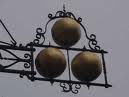
HOCKSHOP

It’s a window next to impossible
to miss unless
you’re hurrying to a particular place
or obsessed with a recent song, or carrying
a face, not just anyone’s,
with you at the time.

I confess I’ve stood there
under the sign lettered GUNS - JEWELRY - LOANS
many times, the window full of
risked, lost, or stolen things,
grieving people’s or dead people’s things,
novelties and knives.

Guilt. Indecision. Everything
is used; each of the hundreds of watches
shows a different time. Guitars,
untuned, hang carefully, gratefully
silent. Which ones, of these alarm clocks,
above the guns, above the stuffed owls,

have cut off a dream and sent a man out
to his death? Some of these paintings,
stacked on the floor, have hung in the finest
banks, and, although it’s kept quiet,
there are those who’ll say the diamonds
were swept from the highway after a fatal crash

that no one remembers. Not even
the broker, the nodder, the blank-faced one
who asks no questions, who, come night,
empties the window, leaves the drawer open
and empty, leaves one light on, sighs,
locks up, drags shut the rusty gates.

Wednesday, July 14, 2010


MESSENGERS

The house itself, if it had a voice
Would speak out clearly. As for me,
I speak to those who understand;
if they fail, memories are nothing.

— Aeschylus,
Agamemnon


We say what we know because we must.
You can cheer us or run us out of town.
It’s nothing at first, like rain on dust,

a hairline crack in the faultline’s crust,
a tentative first-person plural pronoun.
We say what we know because we must

recall, recount, redeem, and readjust
all that we’ve known, not for renown.
It’s nothing at first, like rain on dust,

or the first few tiny flecks of rust
on barrels buried underground.
We say what we know because we must

talk back to histories we do not trust,
relearn our own, and set them down.
It’s nothing at first, like rain on dust.

What does it mean to fear what’s just?
You can cheer us or run us out of town.
We say what we know because we must.
It’s nothing at first, like rain on dust.

Friday, July 09, 2010


NUDE DESCENDING A PRAYER

Father Art, on earth, above those past
the hours of their deaths, thou Mother
under us for who knows how long now,
thy names be with me. Fruit of wills
repeatedly and variously done on earth,
who will pray for us? Sinners? I believe
in clay and constellations and what accidents
allow us to forgive ourselves again for being
in such debt, for owing bread, for being tempted
to make believe, to lie, to sleep forever. Amen.

Tuesday, July 06, 2010


Another from Without Paradise:


THE SLOTH

I live entirely for my own sake.
I once had friends, some money, plans, a love,
but what the hell, what difference does it make?

These days it doesn’t pay to stay awake.
I’ve got what I need. I’ve got nothing to prove.
I live entirely for my own sake.

I was the best but couldn’t catch a break.
So here I hang. I should be hanging in the Louvre!
But what the hell, what difference does it make?

Just thinking of work gives me a headache.
I like it here, a bit above it all; why move?
I live entirely for my own sake.

I’ve taken all the shit I’m gonna take.
So take your shining mottoes, squat, and shove.
But what the hell, what difference does it make?

Your lives, your loves, your work: they’re fake.
You’re all stuck in the same timekilling groove.
I live entirely for my own sake.
What the hell, what difference does it make?

Monday, July 05, 2010


It's been a long time since I posted anything here. I only occasionally repost from another blog or website because I had wanted this to be a place where I would make my own contributions to the "genre" of the weblog. This isn't the site of my work, either; that's still my notebook. Having grown up writing with a fountain pen, not moving to the typewriter until my twenties, it is still a great pleasure for me to write in longhand, which is, I think, closer to the speed of my thinking. (I hasten to add that I am in other ways cutting-edge: facebook page, an iPhone, etc.) My point here is to define and more tightly focus this blog. For the next few days or weeks, I will post poems — sometimes with accompanying images — from my first collection, Without Paradise. Although the book is still available, copies are limited now. (I still have a box, and sometimes sell them when I read from the latest book.)

Here is the poem that opens that book:


ELEGY

— for Michael Stephen Hoffman, 1957-1970

Being in us in his new life
is as strange for him
as it is for us to be here

at his grave today
with no one else’s footprints in the snow
and only the trees that guided us

so let it not be winter there.

Tuesday, April 06, 2010


I'm very proud to be a small part of Thoughtcast, which Jenny Attiyeh describes as "a watering hole for ideas." She recorded my reading at The New England Poetry Club on the occasion of my receiving their Sheila Motton Award for best book published in the previous two years. I read with Wendy Mnookin, whose The Moon Makes Its Own Plea is among my favorite recent books.

If you are unfamiliar with this remarkable site, spend some time there. Terrific interviews, thoughtful and thorough. Great readings. Wonderful links.